

Lab-Grown Lies
Guest article: The Bitter Truth Behind Fake Meat
As the Net Zero narrative tightens its grip on public policy and global agendas, one controversial cornerstone stands out as a red line for many citizens: lab-grown meat. Marketed as a sustainable solution to climate change and animal welfare concerns, these synthetic alternatives to traditional meat are gaining traction in boardrooms and political circles—but not without fierce opposition from those who see them as a dangerous, dystopian development.
For many, the idea that ultra-processed, lab-concocted “meat” could replace real, farm-raised food is not only absurd, it’s deeply troubling. Promoted with buzzwords like “sustainable,” “cruelty-free,” and “eco-friendly,” lab-grown and plant-based meat products are being championed as the future of food.
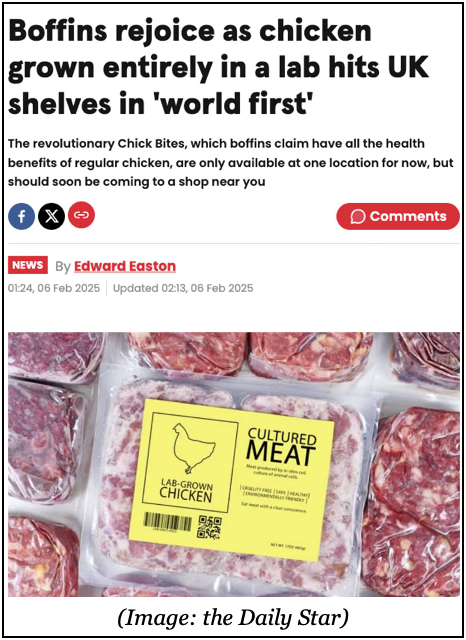
But behind the sleek branding and greenwashing lies a cocktail of chemical slurries, industrial seed oils, synthetic binders, and artificial flavourings that few people fully understand—and even fewer can pronounce.
It’s not food. It’s engineered junk dressed up in green packaging, and the public is being gaslit into thinking it’s better for their health and the planet.
The so-called benefits of lab-grown meat are repeated endlessly in media and policy briefings, but what’s often left unsaid is more revealing. These products are highly processed, often containing compounds such as soy protein isolate, methylcellulose, and synthetic heme. The long-term health impacts are still largely unknown. And that’s not an oversight—it’s by design. There’s a deliberate lack of transparency when it comes to clinical research or independent, long-term studies.
What’s beyond doubt is the powerful backing these products receive. Billionaires, multinational food conglomerates, and venture capital firms have poured billions into synthetic meat start-ups. But is their motive truly environmental salvation, or something more sinister, like monopolising the global food supply?
Meanwhile, small-scale farmers raising real meat—often regeneratively and locally—face demonisation, red tape, and carbon taxes. It’s a classic bait-and-switch: discredit natural foods while selling hyper-industrial substitutes as progress.
And all the while, the billionaires with God complexes who push these narratives continue to enjoy their filet mignon and organic fare, far from the synthetic sludge they promote to the masses.
Bill Gates is one of the most prominent advocates of synthetic meat. He’s heavily invested in companies like Beyond Meat, Impossible Foods and Upside Foods. He’s publicly stated that “rich nations should shift entirely to synthetic beef”. Meanwhile, he owns more farmland in the U.S. than anyone else! Richard Branson and Jeff Bezos have also thrown money into the lab-grown meat space, claiming it’s for sustainability, but ultimately looking to capitalise on a global dietary shift.
Bezos have also thrown money into the lab-grown meat space, claiming it’s for sustainability, but ultimately looking to capitalise on a global dietary shift.
Major investors like BlackRock, Vanguard and SoftBank have poured billions into synthetic food companies. They don’t do this out of love for the planet – they do it because they see a chance to dominate the food supply chain of the future.
Food giants such as Nestlé and Tyson Foods (the same mega-corporations that brought you factory farming) are now pivoting to lab meat to maintain dominance and organisations like the Good Food Institute, backed by Silicon Valley elites, are lobbying governments to fund and promote fake meat.
Let’s not forget that the media and other influencers are paid or incentivised to promote fake meat narratives so you’re more likely to see glowing headlines about lab-grown burgers than any deep scrutiny of their ingredients, health effects, or the concentration of power behind them.
This isn’t just about food—it’s about control. What we eat, who produces it, and who profits. The push for fake meat is a symptom of a broader agenda to centralise power under the guise of sustainability. The public must ask: Who benefits from this transformation, and what are we sacrificing in the process?
The line must be drawn here. This isn’t just an unpopular policy—it’s a deal-breaker. For those still on the fence, the question is simple: Would you rather eat a steak from a local, grass-fed cow or a lab burger designed by biotech firms and funded by billionaires?
If that answer makes you uneasy, it might be time to get off your knees and push back.
By Mairi Allan
Mairi Allan is a writer and publisher, and co-owner and editor of the Daily Dafty satirical Facebook page, and partner with the sports publishing agency Maranovo. For more information, see Daily Dafty on Facebook and visit Maranovo at maranovo.com.

Right of Reply: Contact DoD@DeclarationofDumfries.co.uk with additional or alternative information. Anonymity guaranteed.